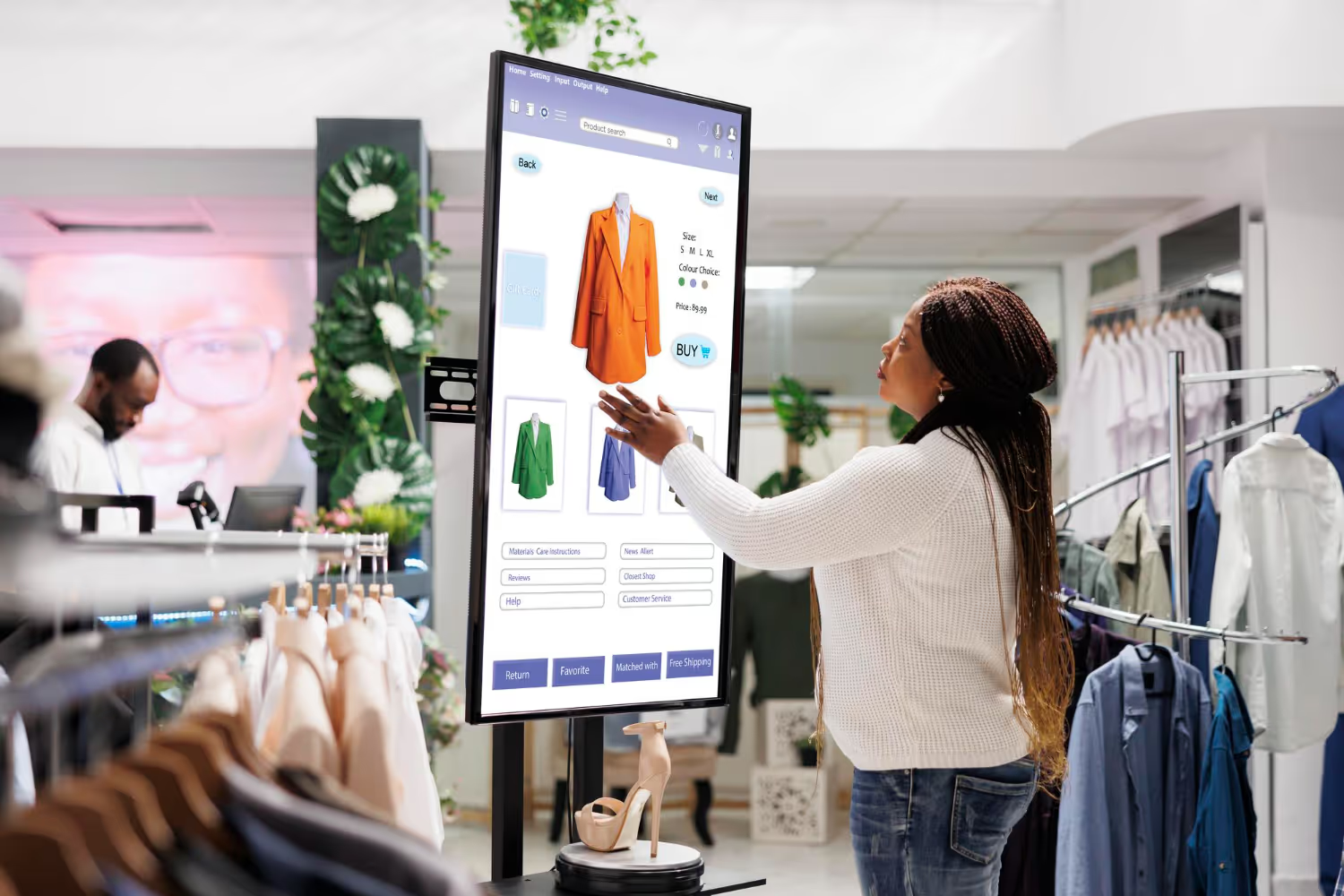
The retail landscape is undergoing profound restructuring in 2026. As digital and physical commerce boundaries blur, retailers are prioritizing seamless omnichannel experiences, AI-driven personalization, and operational resilience. The industry's most successful players are those treating online and offline as integrated components of unified customer journeys rather than competing channels.
Omnichannel integration becomes operational necessity
Omnichannel retail is no longer a strategic roadmap item,it's become a competitive necessity. According to Deloitte research, enhancing omnichannel experiences ranks number one among business leaders' growth opportunities, with 46% identifying it as their most important initiative. Retailers like Walmart, Home Depot, and Lowe's are demonstrating how bridging digital and physical experiences directly drives conversion rates and customer loyalty.
Optimove's research on omnichannel retail trends shows that in 2026, performance will be based on relevance, speed, and coordination across every customer touchpoint. Customers expect connected experiences that are accurate, fast, and personal,with AI personalization and unified inventory management essential for meeting these demands.
AI-Powered personalization moves beyond Front-End
Artificial intelligence is shifting away from visible customer interfaces into core operational decision-making. National Retail Federation's 2026 predictions highlight that retailers are intensifying their AI focus through intelligent forecasting, automation, and logistics efficiency to safeguard margins while improving customer experiences. Agentic AI pathways continue driving improved personalization and operational efficiency.Clarkston Consulting's ecommerce trends analysis shows that AI-driven capabilities enable customized promotions, predictive pricing, dynamic content, and AI-powered customer service at scale. Data indicates 65% of ecommerce brands report higher conversion rates after implementing personalization strategies, with AI enabling the same personal touch that previously required in-store experiences.
Unified commerce and Real-Time inventory management
Inventory accuracy has evolved from hygiene factor to direct revenue lever. Digital Commerce 360's ecommerce trends report notes that overselling, delayed shipments, and cancellations undermine customer trust and marketplace performance. Accurate inventory data drives better fulfillment, fewer cancellations, and higher margins.
According to Simple Bundles' omnichannel analysis, companies implementing AI-powered inventory management have reduced inventory costs by 10-15% while improving supply chain efficiency by 20-25%. Real-time visibility across ecommerce sites, physical stores, dark stores, and marketplaces is essential for seamless omnichannel operations.
Warby Parker exemplifies this approach, using AI forecasting to manage inventory across ecommerce and physical retail, analyzing sales data, website traffic, and broader demand signals to predict which products will be needed at each location, improving accuracy and reducing stockouts.
Social commerce acceleration and platform expansion
Social commerce is projected to drive $1.2 trillion in sales according to Insider One's analysis. TikTok Shop creates native ecommerce experiences within the app, while Facebook Shops provide branded storefronts directly on business pages. These features transform social engagement into shopping opportunities, with influencer-driven campaigns leveraging trusted creators to showcase products to engaged audiences.
User-generated content provides authentic social proof driving purchasing decisions more effectively than traditional advertising. The discovery-to-purchase path shortens dramatically when customers can buy products the moment inspiration strikes while scrolling their feeds.
Headless and composable commerce adoption
Clarkston's retail consultants highlight that retailers are shifting from monolithic platforms to modular, API-first headless architectures. These systems decouple front-end from back-end, enabling flexible experiences and quick pivots across mobile, voice, and emerging channels.
Retailers like Shoe Carnival adopted headless architectures seeking to update product assortments and introduce styles more frequently. Composable architectures take customization further by treating every platform aspect,cart, search, payments,as independent components, allowing organizations to assemble best-in-class solutions for every function.
Fulfillment becomes demand accelerator
Fulfillment strategy fundamentally affects whether sales happen at all. Digital Commerce 360's comprehensive analysis shows that fast delivery, accurate stock levels, and consistent execution influence product rankings on marketplaces and customer purchase decisions. Fulfillment now shapes visibility and conversion, not just post-purchase satisfaction.
Distributed and regionalized fulfillment networks are becoming essential, with inventory placed closer to customers reducing transit times and managing risk while maintaining consistent service across regions. As ecommerce growth increasingly depends on execution capacity rather than demand generation, businesses with scalable systems and responsive operations are better positioned to absorb change and scale sustainably.
Returns management as strategic capability
Returns are no longer treated as unavoidable losses. According to industry analysis, smarter reverse logistics, faster restocking, and clearer visibility into returned inventory are becoming essential for cost control, customer satisfaction, and resale recovery in high-volume ecommerce environments. Brands managing returns well will outperform competitors, with unified systems ensuring returns don't become cost burdens.
Conclusion
Retail leadership in 2026 belongs to those executing operational excellence across integrated channels. Success requires investment in unified commerce infrastructure, AI-driven decision-making, and customer-centric operational resilience that enables rapid adaptation to evolving market dynamics.